Agents that work, improve, and answer to someone
Oct 8, 2026 · @Nunzio Fiore
Orchestrating is easy, governing is the real job
In 2026, orchestrating agents has become easy: open source libraries, workflow platforms, and the model makers themselves all do it. The real question comes afterward, when an agent enters a company's mailbox, management software and documents. Who authorized it, with what credentials, within what limits, and who decides when it changes?
AIsuru was built to answer this question. It's the platform where a European company's agents work on real systems, learn from their own work, and remain under the supervision of a person. It rests on three choices:
- Governance of action: every agent is born inside a gateway that keeps credentials away from the model, verifies who is asking, and logs every action
- The perimeter decided by the customer: European cloud, dedicated tenant, private cloud or on-premise, even isolated from the network, with the model chosen per use case
- Who builds: the company's own people, without writing code, with connectors built once and reused by everyone
Below is the updated catalog, how agents become autonomous without escaping control, and four use cases built by combining connectors.
The catalog today: 48 connectors, eight from the Suite
The public catalog counts 48 connectors as of October 7, 2026: eight are from the AIsuru Suite, developed by Memori, the others connect agents to the systems companies already use. Each connector has a public page with what it does, what's needed to connect it, and example requests.
| Area | Connectors | What an agent does with it |
|---|---|---|
| AIsuru Suite | Vibe Coder, Document Archive, Persistence, Skills, Scheduler, Data Analysis, Network, Agent Link | Builds applications, remembers, follows procedures, works alone, collaborates with other agents |
| ERP and management software | SAP S/4HANA and ECC, IBM Db2 for i (AS/400), Oracle Database, Microsoft Dynamics 365, Firebird | Reads customers, orders, items and stock even from management software running for twenty years |
| Data and analytics | Snowflake, PostgreSQL, MySQL, Microsoft SQL Server, MongoDB | Queries data with SQL or with Snowflake's semantic tools, read-only by default |
| CRM, sales and payments | Salesforce, HubSpot, TeamSystem CRM in Cloud, Stripe | Manages opportunities and quotes, rereads every CRM write, reports on collections and unpaid invoices |
| IT services and projects | ServiceNow, ServiceNow Projects and Portfolio, Linear, ClickUp, Monday.com, Glacier, Sentry | Reads incidents, projects and milestones, opens tickets if enabled, works on issues like a colleague |
| Daily work | Outlook, Work IQ for Microsoft 365, Google Workspace, SharePoint, Microsoft Loop, Word, Excel, Gamma | Mail, calendars, documents, spreadsheets and presentations |
| People | Workday | Organizations, people profiles, reporting chain, read-only |
| Web and automation | Fetch Url, Wikipedia, Ghost CMS, Cloudflare, n8n, Zapier, OAuth / API Connector | Web content, publishing, existing workflows, any REST API |
The catalog isn't a fence. An MCP server not listed can be connected by providing its address, and any API can be described to the OAuth / API Connector without writing a server. Companies then have their own corporate connectors, set up by the administrator with credentials already inside and visible only to the people and groups chosen.
Autonomous agents that improve, with a person in command
An AIsuru agent can work on its own and improve over time, and every step that changes its behavior passes through a person.
Autonomy comes from the Suite's connectors. With the Scheduler the agent runs recurring tasks without anyone prompting it, split into steps with the connectors allowed for each. With Persistence it remembers states, preferences and outcomes; with Network it queries other agents; with Agent Link it makes itself available to other systems.
Evolution comes from the Vibe Coder. The agent reads the questions it couldn't answer and its own statistics, proposes improvements to the prompt and content, builds new views and applications, and can repeat this cycle on schedule. The functions that build require the owner, who approves changes to behavior without ever losing the rules they wrote. Every write is real, logged and reversible.
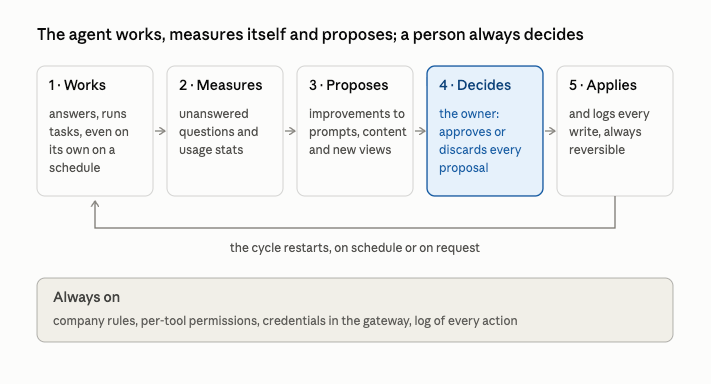
the supervised evolution cycle
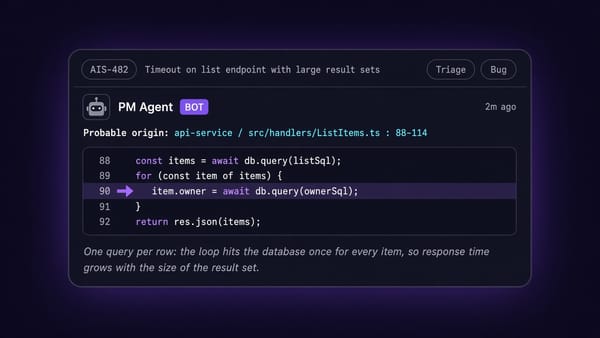
It already happened at home: Memori's technical project manager wrote its own prompt and configured its six scheduled tasks on its own, after the CTO had defined its role and limits (the story).
Case 1: Agent that prepares the Monday leadership meeting
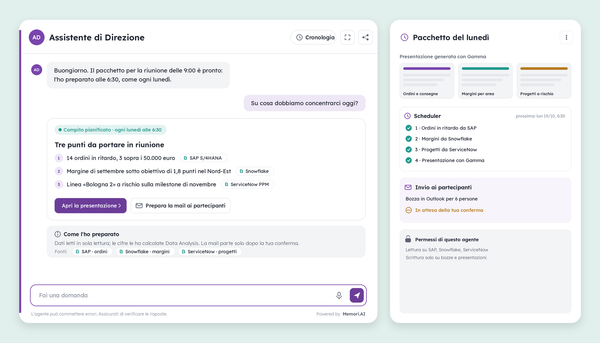
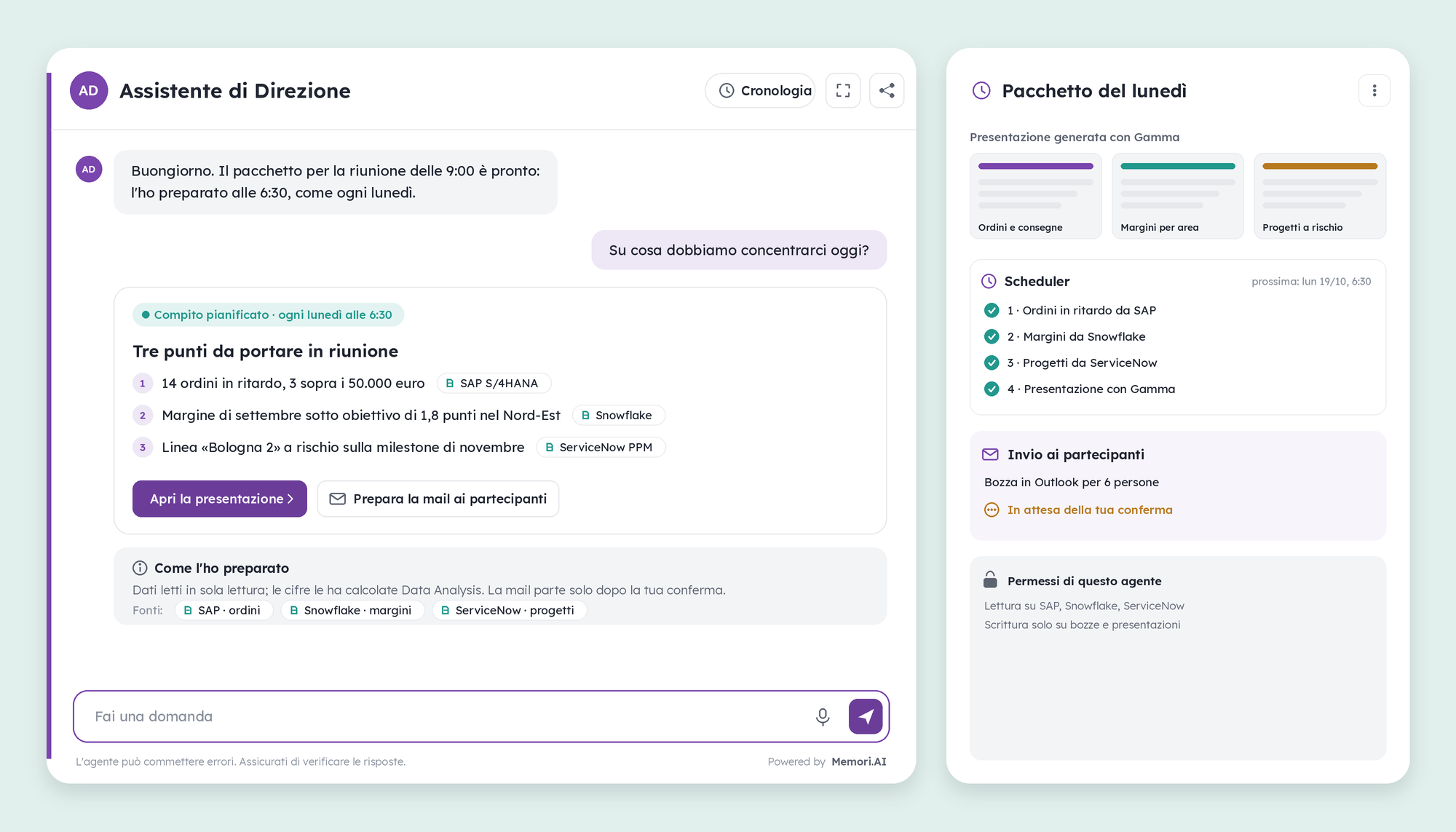
Every Monday at 6:30 an agent prepares the leadership meeting on its own, cross-referencing four systems, and leaves sending to a person. This and the following cases are examples built with real connectors from the catalog; companies, people and numbers are fictitious.
Level 6 · Orchestration
What it's for
- Arriving at the meeting with the week's problems already identified, instead of spending Monday morning across three different systems.
- Giving leadership calculated numbers and a ready presentation, with the source of each data point.
What it does
- Starts on its own with the Scheduler, in four steps, each with only the connectors it needs.
- Reads overdue orders from SAP, margins from Snowflake, and project status from ServiceNow's projects and portfolio module.
- Has Data Analysis calculate variances and thresholds, then builds the presentation with Gamma.
- Prepares the draft email to participants in Outlook and leaves it pending.
Connectors: Scheduler, SAP S/4HANA, Snowflake, ServiceNow Projects and Portfolio, Data Analysis, Gamma, Outlook.
Supervision: reads systems read-only and writes only drafts and presentations; the email goes out when the person confirms.
Case 2: Technical support agent that improves every week
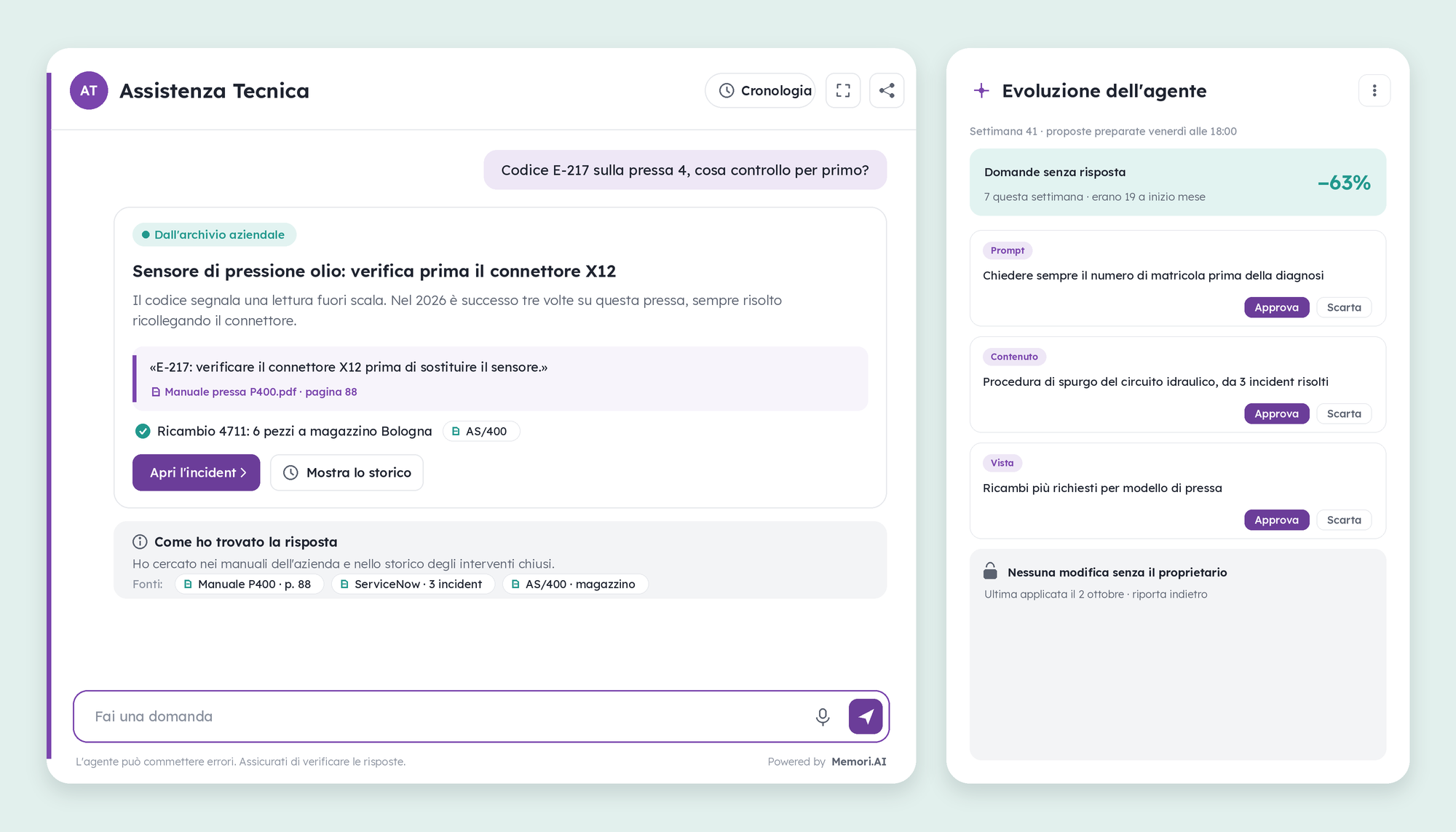
A support agent answers technicians with manuals and history, and every Friday proposes how to improve itself: the owner approves or discards, one proposal at a time.
Level 5 · Persistent memory
What it's for
- Giving the technician the most likely cause and the available spare part in seconds, with the document and page it comes from.
- Reducing week after week the questions the agent can't answer, without anyone having to rewrite it from scratch.
What it does
- Searches the Document Archive for machine manuals, even scanned ones, and cites document and page.
- Retrieves already-resolved incidents with the same code from ServiceNow and spare part availability from the AS/400.
- Keeps intervention outcomes in Persistence, so it recognizes recurring cases.
- Every Friday at 6pm the evolution cycle reads the questions left unanswered and prepares proposals: a rule in the prompt, new content born from resolved incidents, a view on the most requested spare parts.
Connectors: Document Archive, ServiceNow, IBM Db2 for i (AS/400), Persistence, Scheduler, Vibe Coder.
Supervision: no proposal goes live without the owner's approval; the rules they wrote aren't lost, and every applied change can be rolled back.
Case 3: Agent that prepares the quote and checks it in the CRM
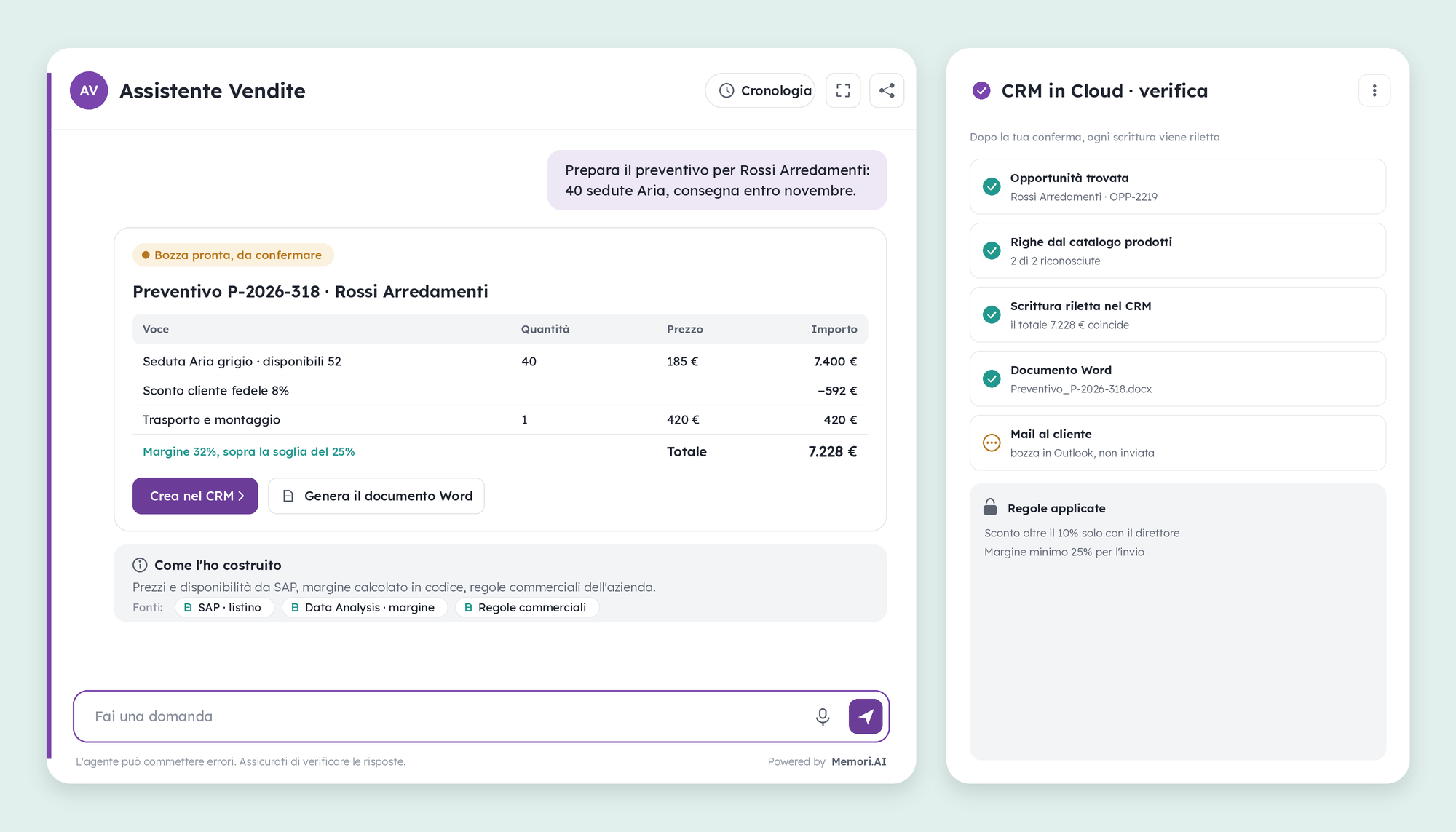
A sales agent builds a quote from a sentence, applies the company's rules and, after confirmation, writes it into the CRM and rereads it before saying it's done.
Level 4 · Actions on systems
What it's for
- Going from a customer request to a quote consistent with price list, availability and sales rules in minutes.
- Avoiding the quote that's been "entered" but doesn't exist in the CRM, or exists with a different total.
What it does
- Reads prices and availability from SAP and has Data Analysis calculate the margin, instead of estimating it.
- Applies the sales rules written by the company, such as the maximum discount without approval and the minimum margin.
- After confirmation creates the quote in TeamSystem CRM in Cloud with the product catalog lines and rereads every write: if the CRM drops a line, it says so.
- Generates the document with the Word connector and prepares the email to the customer in Outlook, without sending it.
Connectors: SAP S/4HANA, Data Analysis, CRM in Cloud, Word, Outlook.
Supervision: the agent proposes, the salesperson confirms creation in the CRM and sending; the discount rules stop the agent before it exceeds the threshold.
Case 4: Agent that builds the non-conformity register by talking
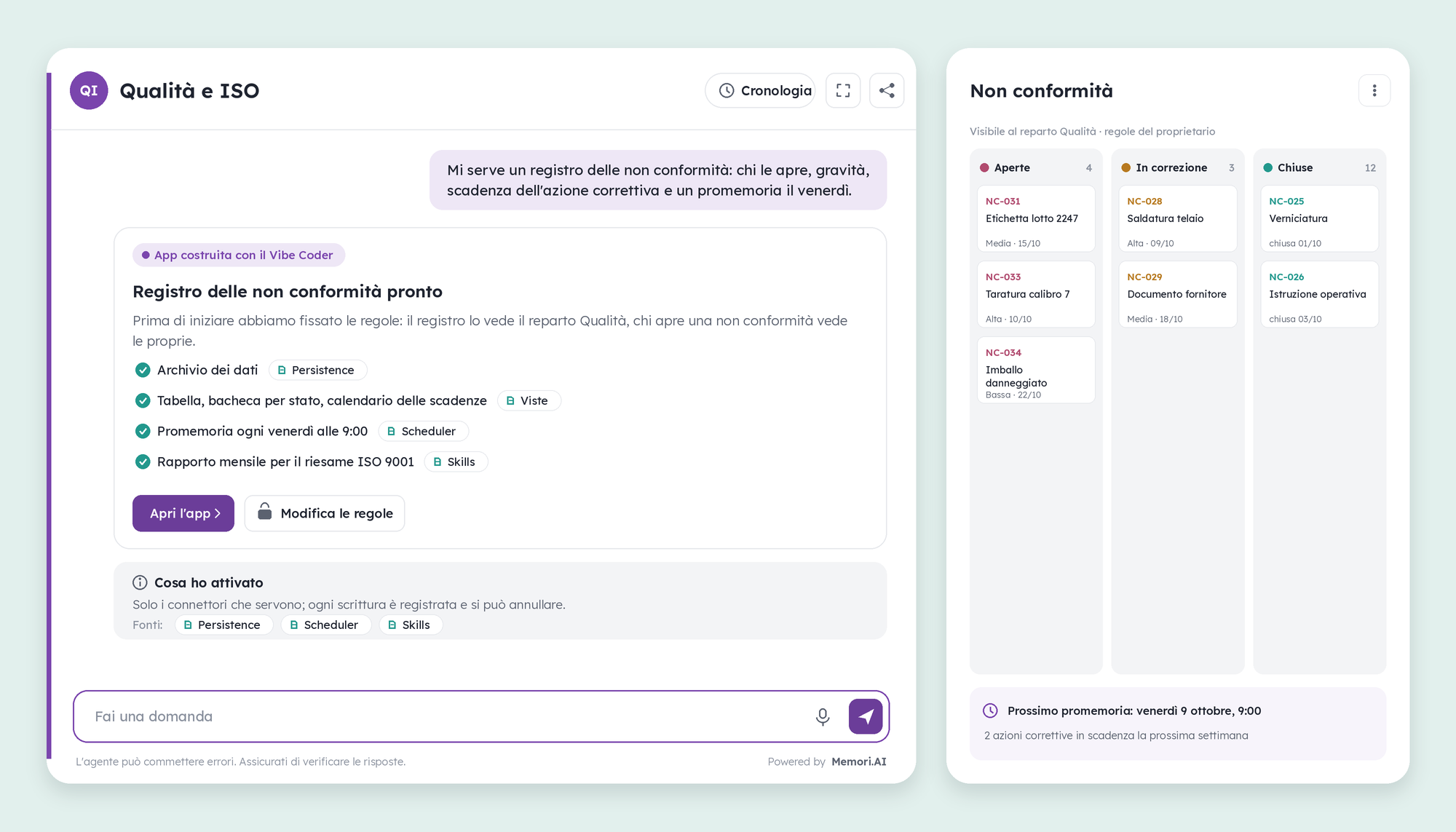
A quality manager describes in two lines the register she needs, and the agent builds it: data archive, views, reminders and monthly report, with visibility rules decided before the first entry.
Level 6 · Orchestration
What it's for
- Having a real application for a process that often lives in a spreadsheet, without opening a development project.
- Arriving at the management review with non-conformities already organized, deadlines included.
What it does
- With the Vibe Coder it asks the owner the right questions and sets the rules: who builds, who sees what.
- Activates Persistence for the data archive and creates three views: table, status board, deadline calendar.
- Schedules a reminder with the Scheduler every Friday at 9am about corrective actions coming due.
- Uses a Skills procedure to prepare the monthly report for the ISO 9001 review.
Connectors: Vibe Coder, Persistence, Scheduler, Skills.
Supervision: building functions are reserved to the agent's owner; every write is logged and can be undone, and whoever opens a non-conformity sees only their own.
What's underneath the cases: governance, perimeter, people
The four cases work because underneath is the same infrastructure, the same for every agent and every connector.
The gateway. Credentials sit encrypted in the gateway and the model never sees them. The identity of whoever asks travels with every execution, so the connector distinguishes what's allowed to one person from what's allowed to another. No permission without a rule, and every action stays logged.
The company's rules. The administrator writes a rule once and decides which agents it applies to; agents inherit it and whoever uses them can read it, with its rationale. Corporate connectors are born with credentials already inside and are shown only to those who need to use them. For governance policy, the platform produces a dated snapshot of the tenant: agents, prompts, tools, roles, rules, models, usage, without the text of conversations.
The perimeter. The same agents run in SaaS on European cloud, on a dedicated tenant, in private cloud or on-premise, even isolated from the network. The model is chosen per use case, frontier or open, and can be changed without rebuilding the agent. The delivery models and the seven third-party audited attestations, from ISO/IEC 42001 to NIS2 compliance, are documented in the Trust Center.
The people. The company's own people build the agents, without code. The AI Academy trains them, and a public program for system integrators prepares partners to integrate the rest.
Trust that can be verified
By now, anyone can build agents. What a company asks for is the trust to let them work on its own systems, and trust is built with written rules, third-party verification, and a person who always decides the last step.
To see AIsuru on your processes: demo@memori.ai, subject DEMO SUITE.
To learn more