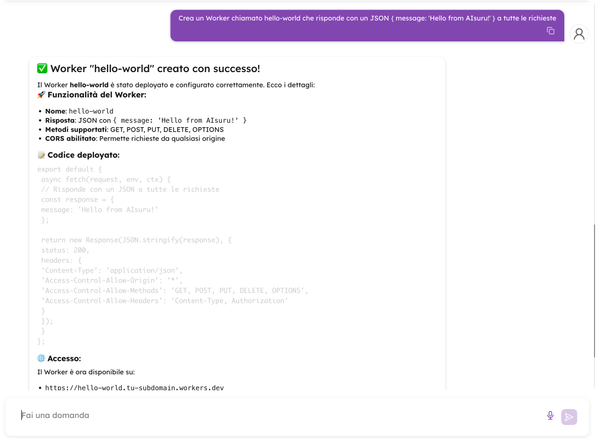
MCP Persistence: your AI Agent now creates and manages databases on its own
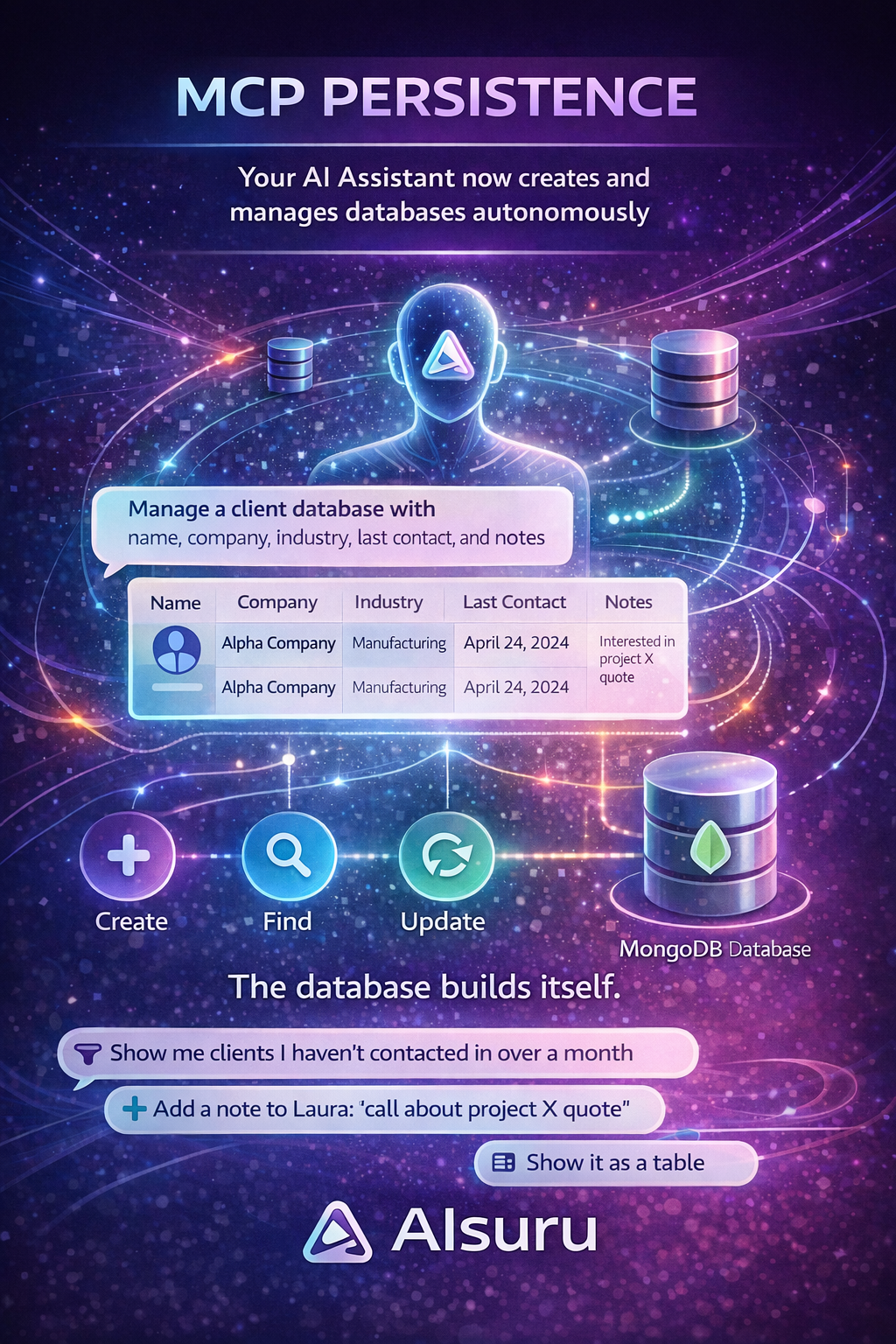
Imagine telling an AI agent: "manage a client directory for me with name, company, industry, last contact date, and notes." No spreadsheet to set up, no database to configure, no application to develop. The agent understands the data structure you need, creates it on its own in its database, and from that moment manages it: inserting, searching, updating, deleting. You keep talking in natural language. It works with the data.
This is MCP Persistence, the new feature available on AIsuru.
A database that builds itself
The logic is simple, the implications are powerful. When you activate MCP Persistence, the agent receives a dedicated MongoDB database and a full set of operations: find, insert, update, delete, aggregate. In the prompt, you describe in plain words the structure of what it needs to manage — collections, fields, relationships — and the agent starts operating.
It doesn't just create records: it creates the schema. It decides how to organize information, maintains consistency, manages relationships between different entities. If you say "add a note to client X that they requested a quote for project Y," it knows where to find the client, where to save the note, how to link them. If you ask "show me all manufacturing clients I haven't contacted in over a month," it builds the query, runs it, returns the result. If you need a table, it renders it directly in the conversation.
The difference from a traditional database is who uses it. No technical skills required, no SQL, no interface to learn. The interface is the conversation.
Anyone can build an application, just by talking
This is where the concept gets interesting. With an agent that manages a database autonomously, anyone in a company can build a custom application simply by describing it.
An event manager says: "manage my team's events with date, venue, confirmed attendees, planned budget, and preparation status." The agent creates the structure, starts recording events, and from that moment answers questions like "what events do we have this month?" or "how much budget have we allocated for Q3?"
A project manager says: "keep a project changelog with date, description of the change, author, and impact." They get a project diary queryable in natural language, without opening a single project management tool.
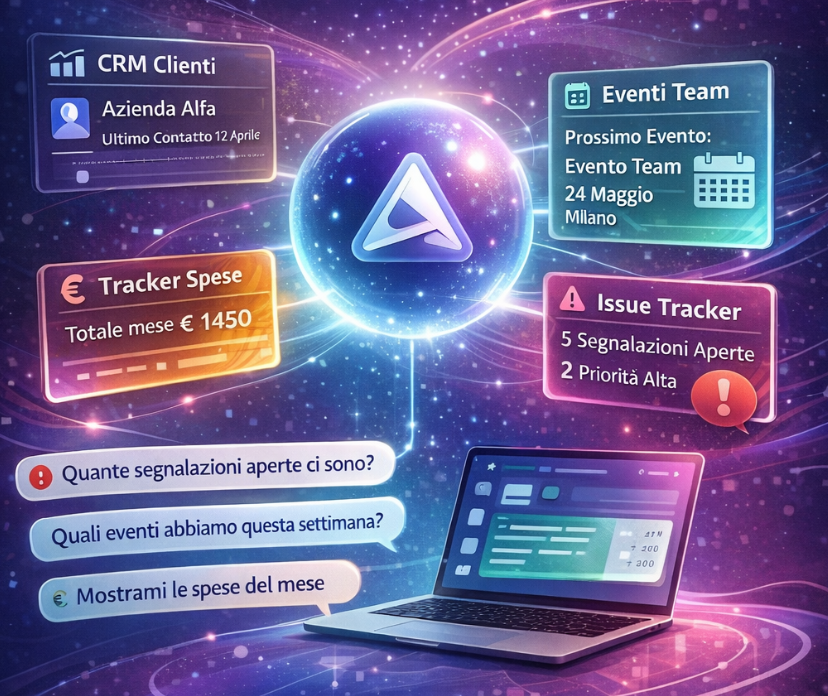
A finance manager says: "track expense reports with date, amount, category, associated project, and reimbursement status." They get an expense tracker they fill by talking and can pull reports from with a question.
A support team says: "manage customer tickets with title, description, priority, customer, assignee, and status." They get a conversational issue tracker, fed directly from customer chats.
None of these scenarios require a developer. None require a software license. The data structure is born from the description, the application is born from use.
Agents that manage data, not just conversations
The real value emerges when autonomous database management combines with integrations already available on the platform.
Take the sales agent integrated with Salesforce via MCP. Today it analyzes the pipeline and suggests next steps. With Persistence, it can autonomously build a parallel database where it tracks strategies discussed with each salesperson, recurring objections for each client, patterns that lead to closing deals. It's not a CRM — it's a layer of operational intelligence that the agent builds and feeds on its own, conversation after conversation. After a month, that agent knows things no Salesforce field contains.
Or take the MCP SharePoint connector we released as open source. The agent reads and writes documents on the company knowledge base. With Persistence, it can build a usage index on its own: which documents are requested most often, which sections generate questions, where people get stuck. Nobody asked it to do this — it does it because it has a database where it can structure these observations and then use them to improve its answers.
Same story for the training agents in the AIsuru AI Academy. With a database at its disposal, the agent can autonomously structure each student's profile: verified skills, identified gaps, completed exercises, quiz results. It doesn't follow a fixed path — it builds a model of the student and adapts the learning journey accordingly.
In all these cases the pattern is the same: the agent doesn't just answer. It collects, organizes, structures. It turns conversations into data and data into better decisions.
The line between chatbot and software
There's a question we hear often: "so is it a chatbot or is it an application?" With MCP Persistence the answer is: it depends on what you ask it to do. An agent with access to a database it manages autonomously can be a CRM, a tracker, an organizer, a registry, a reporting system — anything that boils down to "structured data + interaction." With one difference: you don't develop it. You describe it.
It's the point where conversation stops being just an interface and becomes a way of building software.
Available now on AIsuru.com. For questions, demos, or to tell us what you've built with it: demo@memori.ai