What an AIsuru agent really does: four stories, not a brochure

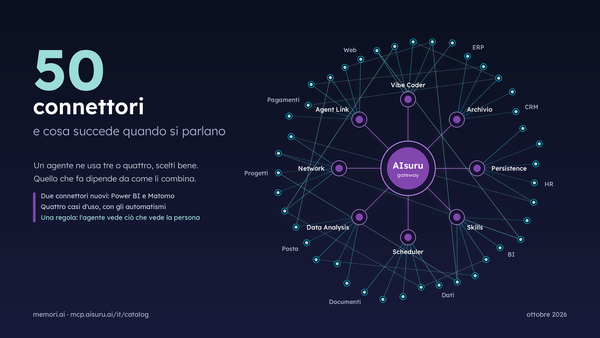
The Suite is now up to seven connectors that talk to each other, inside a catalog of thirty six. But the list doesn't say anything. What says something is the day to day: here are four real people, with made-up names and real problems, and what changes when an agent enters their Monday.
There's a wrong way to tell the story of a platform, and it's listing its parts. Seven connectors in the Suite, twenty-nine toward the systems of the world, databases, mail, calendars, payments. All true, and all useless to read, because no one wakes up in the morning needing a connector. You wake up needing the report to be ready, the customer to get an answer, the shifts to add up.
So instead of the inventory, let's tell four days. The names are made up, the jobs aren't: these are the companies we meet every week. For each story we say which pieces of the Suite come into play, so you can reconstruct the list yourselves, at the end, when it will actually mean something.

Marta, who used to spend Monday writing reports
Marta runs management control at a manufacturing company. Her Monday always started the same way: export the data from the ERP, paste it into a spreadsheet, fix the columns, make the charts, write the commentary, lay it out. A good three hours, every week, for a document someone would then read in three minutes.
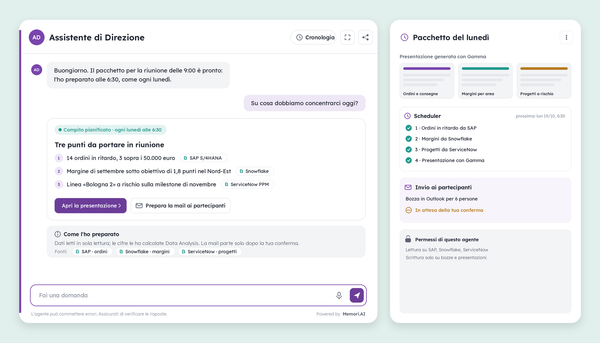
Now the report is on her desk when she arrives. At six in the morning an automation woke the agent up; the agent queried the database where the numbers live, analyzed them, applied the procedure describing how that report is written (format, sections, tone: Marta's own, not a generic template), and remembered what had changed since last Monday, flagging it at the top. No one wrote it. Someone, once, wrote how to write it.
Marta hasn't stopped doing her job: she's stopped doing the part a machine does better. She now spends those three hours deciding what to do with the numbers, which is the reason she was hired.
The pieces at work: the Scheduler that wakes the agent up, a database connector (in her case a legacy ERP via SQL), Data Analysis for the calculations, Skills for the layout, Persistence for remembering what changed.

Surveyor Bruni, who had twenty years of data in a management system no one touches
The Bruni practice has had a management system running since the early 2000s. Inside it, twenty years of case files, clients, land registry records. It works, so no one changes it; but it's a vault whose code has been all but forgotten, and any question a bit different from usual requires calling the one person who knows where to look.
Now there's an agent that queries that database in natural language. "How many open cases in the municipality of Osio in 2019?" becomes an answer in a few seconds, without migrating anything, without touching the management system, read-only for safety. The vault stayed locked; the only thing that changed is that now there's someone at the front desk who knows how to open it on command.
It's not the most elegant connector in the catalog, and it's the one I'm proudest of: because that's where the real work of Italian companies lives, in the management systems no one puts on the cover.
The pieces at work: the connector to the legacy database (native protocol, read-only user), and nothing else. Sometimes one door is the whole revolution you need.

Arianna, who had been answering the same questions for three years
Arianna runs customer service for an e-commerce store. The same questions, every day: where's my order, how do I return something, when will it arrive. She knows the answers by heart, and that's exactly the problem: a job that's known by heart is a job a person shouldn't have to do by hand anymore.
Her agent now lives inside the website and on the customers' channels. It reads order status from the system, answers with real data, and when the question steps outside the known territory it hands off to Arianna with all the context already prepared, instead of making the customer start over. Sensitive procedures (a late return, a refund) follow the steps the office has followed for years, written once in a skill and applied identically every time, with rules and permissions decided in advance, not left to improvisation.
Arianna wasn't replaced: she was freed from the first fifty identical questions so she could handle the fifty-first, the hard one, the one that needs a person.
The pieces at work: the Vibe Coder for the views and the flow, Skills for the return and refund procedures, a connector to the order data, and the onboarding that fixes rules and permissions before the first customer.

Davide, who wanted custom management software and couldn't afford it
Davide runs an artisan business and has a small but daily problem: he tracks orders and materials with a spreadsheet that has grown badly, and custom software costs more than he wants to spend on something like this.
He described out loud to the agent what he needed: what to record, who sees it, who can write to it. The agent asked the right questions, created the data archive, the views to consult it and a form to enter data, and handed him an address. The rules (who can write, what stays private) were decided in conversation, before the first piece of data. No editor opened, no quote, no waiting.
It's the piece that still gets to me, coming from software: a small but real management system, born by talking, in one afternoon. Not for every problem in the world, but for a great many small problems that previously weren't worth the cost of a project.
The pieces at work: the Vibe Coder that builds the app, Persistence as the archive, and the fact that the rules are decided during onboarding and stay stitched inside.
The thread that ties the four stories together
Read them again: they don't have a connector in common, they have a principle in common. In every story the agent doesn't do "everything it could", it does what it's been allowed to do, with the data it's been given, inside boundaries decided beforehand. Marta doesn't worry the agent will touch numbers it shouldn't; the surveyor keeps it read-only; Arianna wrote the refund rules before turning anything on; Davide decided in conversation who sees what.
This is where the difference lies between a toy agent and a working agent. The first impresses in a demo. The second walks into a real Monday, where data is sensitive, permissions matter, and every action leaves a trace. The Suite is built so that when you combine the powers (the Scheduler plus the database plus Skills), the boundaries get combined right along with them.
And there's one last thing true of all four. None of these people learned to code, and none of them bought new software. They described a need to an agent, and the agent used the tools it had. The model proposes; the infrastructure disposes; and the rules, those you set yourself, once, at the start.
The complete catalog, with a page for each of the thirty-six connectors and example requests to try, is public: https://mcp.aisuru.ai/it/catalog
And if you'd like to see one of these four days rebuilt on your own data, in a demo: demo@memori.ai, subject DEMO SUITE.