AI Agents: from chaos to infrastructure. An image to understand where problems come from and how they get solved
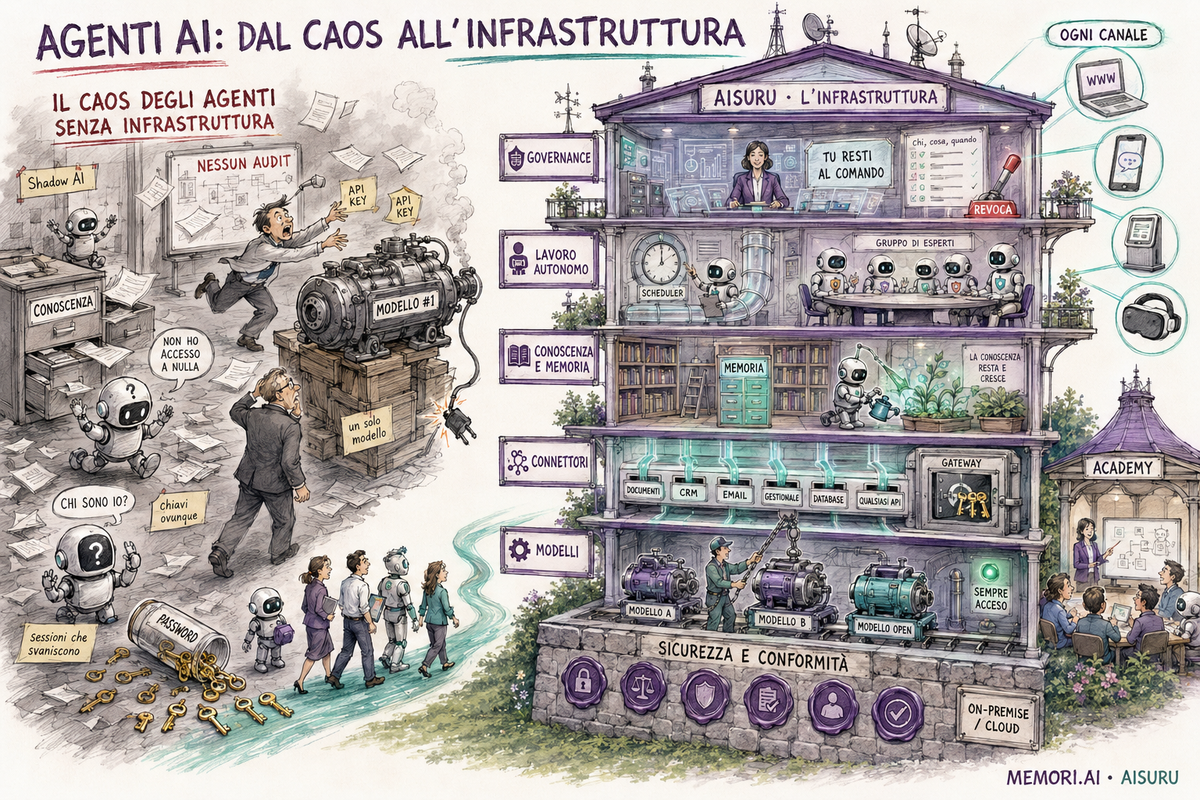
There are concepts we explain every week, in demos, meetings, and workshops. At some point we tried to condense them into a single illustration: on one side, the chaos companies experience when they adopt AI agents without foundations; on the other, the infrastructure that makes those same agents secure, useful, and governed. In between, a path.
This article is a guided tour of that image. We describe it meticulously, detail by detail, because every element of the drawing corresponds to a real problem we encounter in the field or to a concrete component of the AIsuru platform. In the end, the illustration is our thesis in visual form: the model comes and goes, the infrastructure stays.
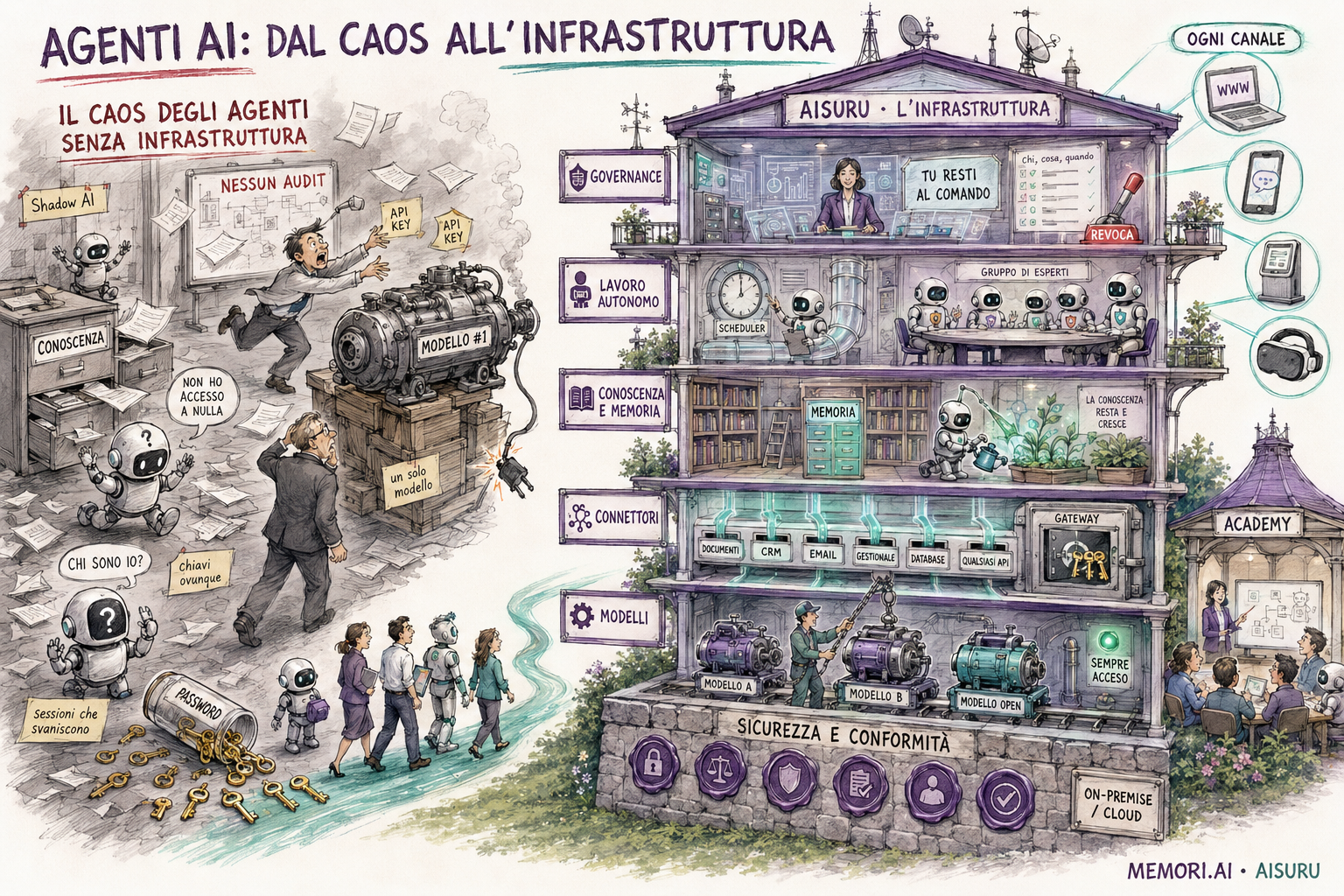
Take a look at the scene on the left: the chaos of agents without infrastructure
The left side of the illustration is deliberately drawn as a messy office, and every detail tells a specific problem.
The robot asking "who am I?"
This is the problem of non human identities: agents operating on company systems without a defined identity, without assigned permissions, with no one able to answer security's fundamental question: who is acting, on whose behalf, with what authorization? This isn't a theoretical problem: industry research shows that the vast majority of organizations are concerned about controlling the identities their agents act with, but only a small fraction have a strategy to govern them.
The overturned password jar.
In the foreground, a container labeled "PASSWORD" tipped over on the ground, with golden keys scattered everywhere. Next to it, an employee chases flying sticky notes reading "API KEY". This is a snapshot of artisanal secrets management: credentials pasted into chats, shared in documents, duplicated across dozens of personal configurations. It's the ground where Shadow AI thrives, and it's the point where company data starts scattering beyond IT's control.
The isolated robot saying: "I have no access to anything."
This is the flip side of the problem: for fear of connecting systems, many companies keep their agents in quarantine. The result is a chatbot that talks but doesn't act. An AI agent is only as useful as the systems it can access: without governed access to documents, CRM, or ERP, it produces no value.
The "KNOWLEDGE" filing cabinet with papers flying away.
The knowledge built during conversations evaporates at the end of the session. Every interaction starts from zero, nothing accumulates, nothing consolidates. This is the difference between using an AI and owning a system that grows.
The "NO AUDIT" blackboard.
No traceability: no one knows who asked what, which data was touched, which actions were taken. Impossible to audit, impossible to demonstrate compliance, impossible to even notice abuse.
The big MODEL #1 on the stack of crates.
This is the most important detail in the scene. A single, enormous engine labeled "MODEL #1", resting on an unstable pile of wooden crates, with the plug coming loose from the socket. This is dependency on a single frontier model: an entire operation built on top of a service you don't control, one that can change terms, prices, or availability overnight. Anyone who followed last spring's news knows this isn't a hypothetical: the most powerful model on the market was suspended for all non U.S. users overnight, by decree. Companies that had built critical processes on top of it found the plug pulled.
The path: adoption is a journey, not a leap
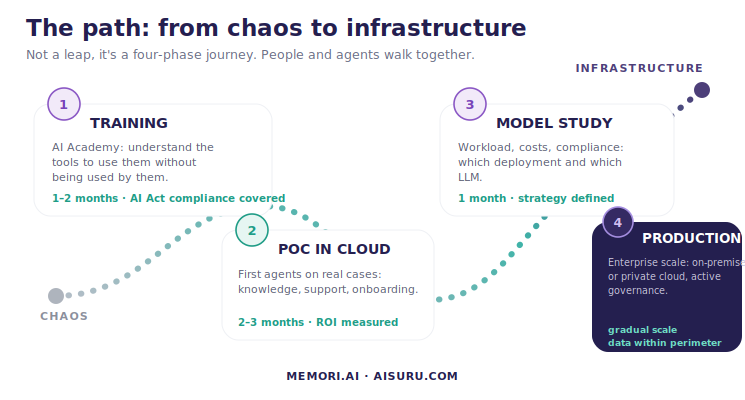
Between the two scenes, a group of people and small robots walk along an aqua-green path, from the chaos toward the entrance of the building. This is the element we care about most, because it contains our methodological conviction: you don't get from chaos to infrastructure with a purchase, you get there with a journey. Training people, proof of concept on real use cases, studying the deployment model, production. People and agents walk together, in the same direction: technology doesn't replace people's journey, it accompanies it.
The building: the AIsuru infrastructure, floor by floor
The right side of the illustration is a building in cross-section, like an architectural dollhouse: you can see everything happening inside. At the top stands the sign "AISURU · THE INFRASTRUCTURE". It's no coincidence that the solution is represented by a building and not a single machine: the entire point is that no single component, on its own, is enough. Let's look at it floor by floor, from the bottom.
Foundations: security and compliance
The building rests on massive stone foundations, with six seals set into it and a plaque reading "ON-PREMISE / CLOUD". These are the two guarantees underlying everything else.
The first is third-party-verified compliance: Memori holds six attestations covering the entire risk perimeter of an agentic orchestrator. ISO/IEC 27001:2022 for the information security management system; ISO/IEC 27017:2021 for cloud-specific controls; ISO/IEC 27018:2020 for the protection of personal data in the cloud; ISO 42001:2023, the first international standard dedicated to AI management, aligned with the EU AI Act; ISO 9001:2015 for quality; and compliance with the NIS2 directive, which includes supply chain security and makes AIsuru adoptable even by entities and companies within the critical perimeter.
The second is deployment freedom: the same platform runs in the cloud, in a private cloud, or fully on-premise, down to isolated environments where data never leaves the organization's perimeter. The foundations, in other words, can be built wherever you want.
Models floor: interchangeable engines, always on
On the first floor there's an engine room with multiple engines on rails: "MODEL A", "MODEL B", "OPEN MODEL". A technician is unhooking one to attach another, while a green light signals "ALWAYS ON". The building never stops.
This is AIsuru's multi-model orchestration: the platform isn't an LLM, it's the layer that governs them. You can use models from major providers with your own API keys, models on Azure or Vertex, fine-tuned models, or open-source models run on your own hardware. The model is chosen based on the task, compared, and swapped at any time, without rewriting anything. If a provider changes the rules, or a model is retired, another one gets hooked onto the rails. The contrast with the scene on the left is intentional and precise: there, a single engine with the plug coming loose; here, interchangeable engines and a building that stays powered.
Connectors floor: every system connected, and the keys in a safe
The second floor is a bright hub with a neat row of outlets, each labeled: "DOCUMENTS", "CRM", "EMAIL", "ERP", "DATABASE", "ANY API". From each outlet runs a clean thread of light. And on the wall, clearly visible but as just one of the floor's components, a safe labeled "GATEWAY", with golden keys locked inside.
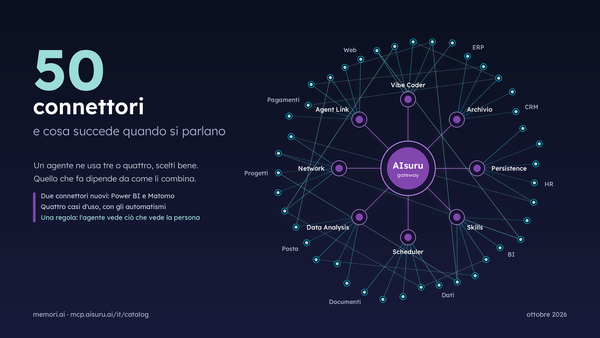
This floor represents AIsuru's integration system: more than twenty ready-made MCP connectors (from the Microsoft suite to databases, from CRMs to productivity tools), Functions for calling webhooks and services, and the Universal Connector, which lets you connect any API by describing its specification, including a custom internal ERP built years ago.
The safe deserves a precise explanation, because it's the most important security detail in the drawing. On the Connectors floor, keys never travel along the wires: they stay locked in the Gateway, which keeps them encrypted and uses them server-side only at the moment an action needs to be performed. From the outlets comes the ability to act, never the secret to do so. The language model receives the result of the operation, not the credentials that made it possible. With Enterprise MCPs this principle rises to the organizational level: the administrator configures a connector once, with company credentials, and all users can enable it on their own agents with a click, without ever seeing or handling the secrets. In the scene on the left, the keys were scattered on the floor; here they exist in one place only, encrypted, revocable instantly.
Knowledge and Memory floor: an archive that stays and grows
The third floor is an orderly library, with a filing cabinet labeled "MEMORY" and, a detail we're fond of, a little gardener robot watering plants whose fruits are data: the caption reads "knowledge stays and grows".
This is the answer to the filing cabinet losing papers in the chaos scene. In AIsuru, the agent's knowledge is a structured, permanent asset: verified Content that anchors answers to facts, imported and indexed documents, a dictionary of company terms, persistent memory that lets the agent create and manage real databases autonomously, and conversational memory extensions that consolidate what the agent learns over time. Every interaction can enrich the system instead of evaporating. It's the difference between renting a session and owning software that keeps being trained: a medium for transmitting knowledge, like a book or a course, but alive, updatable, and capable of answering.
Autonomous Work floor: the scheduler and the experts' table
Two things happen on the fourth floor. On the left, a hardworking robot works next to a large wall clock labeled "SCHEDULER" and feeds reports into a pneumatic tube that delivers them. On the right, a round table around which several robots with different badges sit, under the label "GROUP OF EXPERTS".
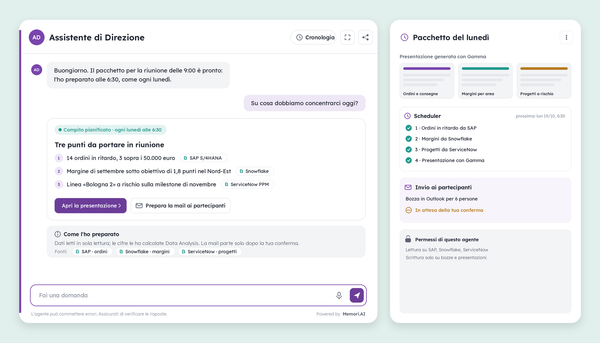
These are the platform's two forms of governed autonomy. The Scheduler lets agents perform recurring, scheduled tasks without human intervention: reading inboxes, updating data, producing and delivering reports at set times. Groups of Experts are multi-agent orchestration: several specialized agents, each with its own identity and expertise, collaborating on the same problem, coordinated by a director that routes questions to the right expert. Autonomy, in both cases, lives within the rules of the lower floors: identity, permissions, governed connectors.
Penthouse: Governance. You stay in command
This is the governance floor, and it's no coincidence it sits at the top: it sees and controls everything happening below. In the product, it corresponds to the tenant administration area: centralized management of users and agents, Single Sign-On with company identity, role-based access control, conversation retention policies, publishing of Enterprise MCPs, traceability of operations. The revoke lever is literal: a closed permission or a rotated key applies everywhere, instantly, for every agent. And the self-writing log is the audit: every action leaves a trace without anyone needing to remember to record it. Human oversight isn't a statement of principle: it's a room in the building, with a person inside it.
The roof: every channel
From the roof of the building, thin bridges of light reach a laptop, a smartphone, a kiosk, a VR headset: the label reads "EVERY CHANNEL". An agent built once is published wherever it's needed: embedded on a website, integrated via WhatsApp Business, installed on physical kiosks, brought into virtual environments and augmented reality, or called via API inside your own applications. The infrastructure sits underneath, the experiences, on top, multiply.
The pavilion next door: the Academy
Outside the building, but connected to it, a pavilion with a classroom: a teacher at the blackboard and people learning. This is the AIsuru AI Academy, and its position in the drawing is a statement of method: you don't enter an infrastructure with a purchase, you enter it with understanding. Training, which the AI Act moreover makes mandatory for those using artificial intelligence systems, is for us the first step of every adoption: people who understand the tools use them better and don't get manipulated by them. People before algorithms.
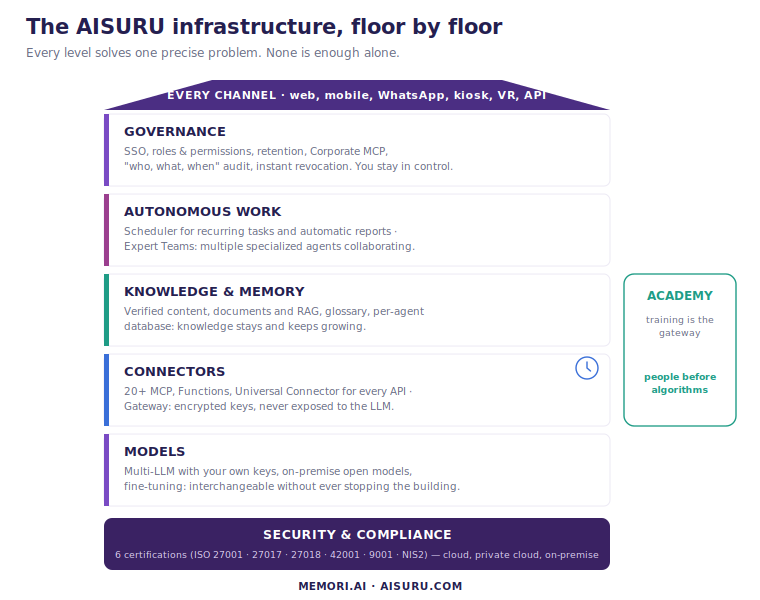
Why you need the whole building
Looking at the image as a whole, the point closest to our hearts emerges. Every problem in the scene on the left finds its answer in a specific floor of the building: the scattered keys in the Gateway's safe, the identity less agent in the penthouse governance, the isolated agent in the Connectors floor's outlets, the vanishing knowledge in the growing library, the engine with the loose plug in the Models floor's rails.
But none of these answers would work alone. A gateway without governance is a safe with no one responsible for it. Interchangeable models without connectors are powerful engines in an empty room. Memory without security is an exposed archive. It's the whole building, with its floors supporting each other, that transforms AI agents from a risky experiment into a production system.
That's why we say the right question, for a company, isn't "which model should I choose?" It's: "which infrastructure keeps me in command, whichever model wins?"
The model comes and goes. The infrastructure stays.