AIsuru Skills: write the procedure once, the agent follows it forever.
In every company, operational knowledge lives in three places: in someone's head, in a PDF nobody opens, and in the memory of whoever was there last time. The meeting minutes get written "the way Franca does it," a complaint gets handled "the way the guy who's now retired used to say," the monthly report has a format that exists only because someone remembers it. Then Franca goes on vacation, and it turns out the procedure was never written down anywhere.
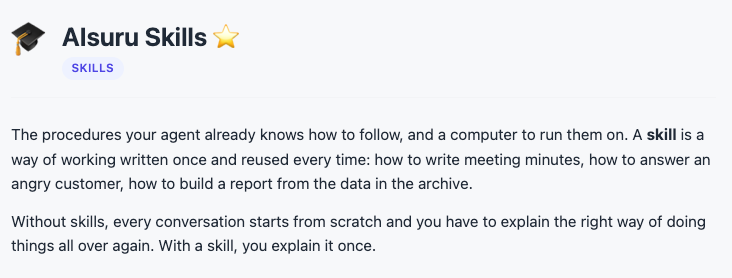
AIsuru Skills exists for exactly this: a skill is a way of working, written once and reused forever. How to draft meeting minutes, how to respond to a complaint, how to prepare a report from data, how to lay out a document. And the agent finds them on its own. When a user's request matches a procedure it knows, it reads the instructions and applies them with the tools it already has.
A standard format, not one of our own
The most important choice is invisible. Skills use the SKILL.md format, the open standard adopted by Claude and other agents. A header with name and description, then instructions in markdown. That's it.
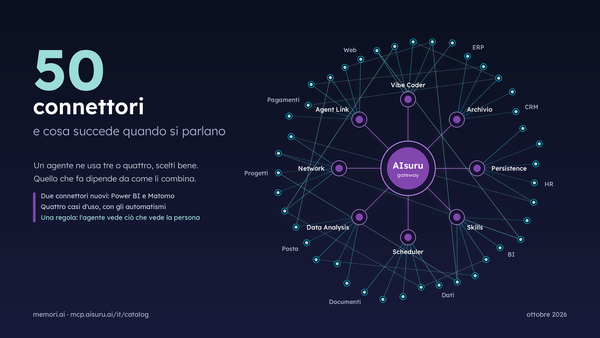
There are two consequences, and both matter. A procedure written for AIsuru also works elsewhere, and a procedure found elsewhere (written for Claude, published on GitHub, shared by a colleague) pastes in unmodified. Expertise stops being a prisoner of the platform it was born on: write it once, and it works everywhere. For readers of our connector map, the principle is the same: open standards, not proprietary fences. Fences, as we'll see shortly, we reserve for something else.
There's an implementation detail worth telling, because it says a lot about the philosophy. Each skill's description must also state when to use it, in the words a user would actually use: that's the line the agent uses to decide whether the procedure kicks in. And if the owner finds themselves explaining the same way of working for the second time, the agent itself offers to save it as a skill. An agent that asks to learn, instead of pretending to remember.
How the agent works with skills
The flow is designed not to waste context, which for a language model is the scarce resource. First the list: names, purposes, and usage conditions, without loading the full instructions. Then opening the chosen skill, with a rule that raises eyebrows among people who build models: the procedure's instructions outrank the model's habits. It's not a suggestion, it's a hierarchy: the company procedure commands over how the agent would otherwise do that thing on its own.
Attached deep-dives (templates, forms, long lists) open only when the instructions send you there, and they exist precisely so as not to take up memory until needed. And before promising a result, the agent can check whether the skill has everything it needs on that agent: which connectors it requires, which are present, which are missing. Better to know beforehand than halfway through the work, and even better that it's the agent saying so, rather than the user discovering it.
Saving and deleting skills remains reserved to the owner. Whoever converses uses the procedures; whoever owns governs them: it's the same separation between consumer and builder that runs through the whole platform.
The leap: when the procedure actually executes
So far, instructions. But many procedures don't end with words: they end with a file. A chart from sales data, a document laid out with the right logo, a PDF, even an edited video. This is where AIsuru Skills takes the leap: when the work is done by executing rather than describing, the agent runs real Python code and returns the produced files as links.
The toolkit is what an analyst would expect: pandas and numpy for data, matplotlib for charts, openpyxl, python-docx and python-pptx for the Office family, reportlab and pypdf for PDFs, qrcode, jinja2, markdown, and command-line ffmpeg for audio and video. Enough to turn "prepare the monthly report" from a text request into an actual document delivery.
The fence, which is the real product
Giving an agent the ability to execute code written in a procedure is powerful. And it's exactly the kind of power that, without boundaries, becomes an accident waiting for a date. That's why the part we're proudest of is the fence containing it, even more than the execution itself, and it's stated in full in the connector's public info page.
Every execution lives in a disposable folder that disappears at the end. Disk access is confined to that folder at the kernel level (Landlock ABI 4): the code can't read anything outside it. The network is closed: no downloads, no pip install, no API calls. Time is limited: 20 seconds by default, up to 120 for heavy jobs, with 2 gigabytes of memory. Any data needed is fetched beforehand, through authorized connectors, and passed to the skill as a file: the execution doesn't go looking for it on its own.
It's default-deny applied to code execution, the same posture that governs connectors: no rule doesn't mean everything is allowed, it means nothing is allowed. And there's one line, in the instructions the agent receives, that sums up the system's ethics better than any brochure: if the code fails, the error goes back to the agent, which must read it and retry, don't report a result you don't have. The oldest temptation of language models, defused by a platform rule.
The counters start at zero
The skills panel shows the available procedures, executions over the last seven days, how many failed, average duration, files produced. At launch the catalog starts with seven ready made skills, written by us, and the counters read zero: zero executions, zero failures, zero files.
We could have waited a few weeks and shown you more photogenic numbers. We prefer real zeros: those counters exist so the owner can see what their agent actually executes, not to put on a show. They'll fill up at the pace of real use cases, including the failures column, which is exactly what makes them credible.
What you'll do with it tomorrow morning
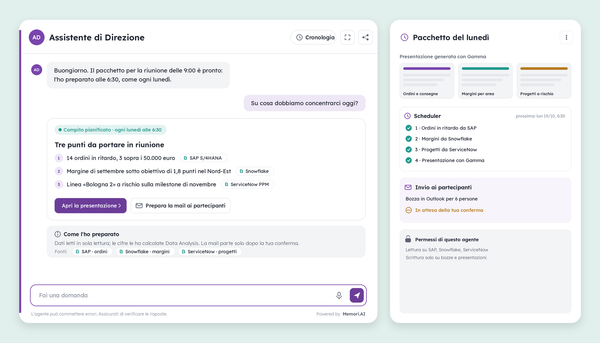
The monthly report: a skill describing format, sections, and tone, the database connector bringing in the numbers, the execution laying out the document. Meeting minutes: your structure, your mandatory fields, your way of writing down decisions, applied identically every time. Complaint responses: the steps the office has followed for years, finally written down, with the agent following them even when Franca is on vacation.
And the moral is the usual one, with one more piece added. The model proposes, the infrastructure disposes. Now also: the procedure commands, the fence contains. Your company's expertise becomes a text written once, governed like an asset, and working every day, within boundaries that don't depend on anyone's goodwill — the model included.
The connector is in the public catalog, with the full info page and the instructions the agent receives, reported word for word: https://mcp.aisuru.ai/mcp/info/aisuru-skills-mcp-server
To see it work on one of your own cases: demo@memori.ai, subject DEMO SUITE.